
One Man’s Mission to Bring the Music of Loons Back to West Battle Lake – Steve Slatten WBLLA Board Member
One Man’s Mission to Bring the Music of Loons Back to West Battle Lake – Steve Slatten WBLLA Board Member
Story by Barbie Porter April 22, 2026 Fergus Falls Journal
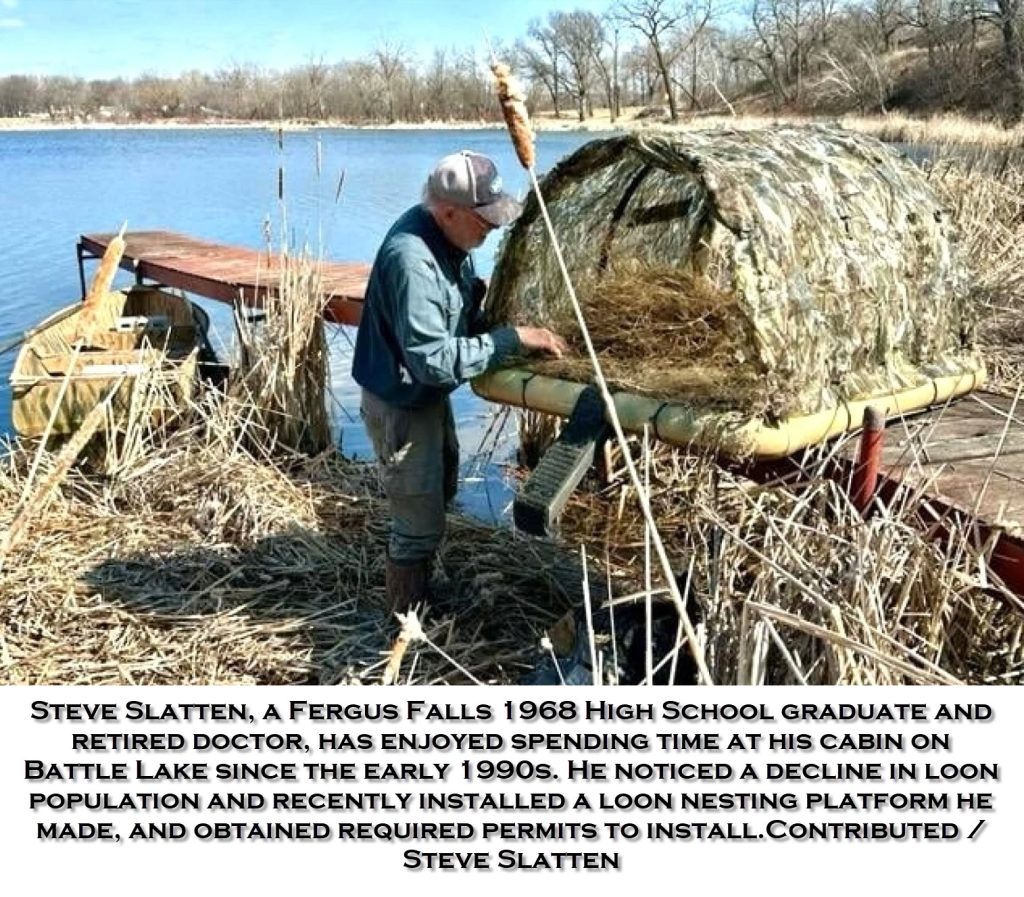
Steve Slatten, a Fergus Falls man with a summer lake home on Battle Lake, built a floating loon nest in hopes of restoring the lake’s loon population. Steve Slatten is hoping to return the loon population on Battle Lake to what it was years ago.
—–
“I’ve had a cabin on Battle Lake since 1992,” he said, noting he used to see a half dozen loons in the spring. Now, springtime in the east bay is relatively quiet with just a few loons, he said. “In the fall, around Labor Day, there used to be hundreds of them; literally hundreds. And now, there may be dozens.”
—–
Slatten, who lives near the Twin Cities and grew up in Fergus Falls, learned the ice in the southeast part of the bay had recently melted. With open water, he went to the family cabin, pulled mud from the bottom of the basin and caked it inside the loon nesting platform he had built. Then, he filled it with about a foot depth of dead grass and brought it out in his boat.
“It’s about 15-20 feet off the shoreline,” he said.
—–
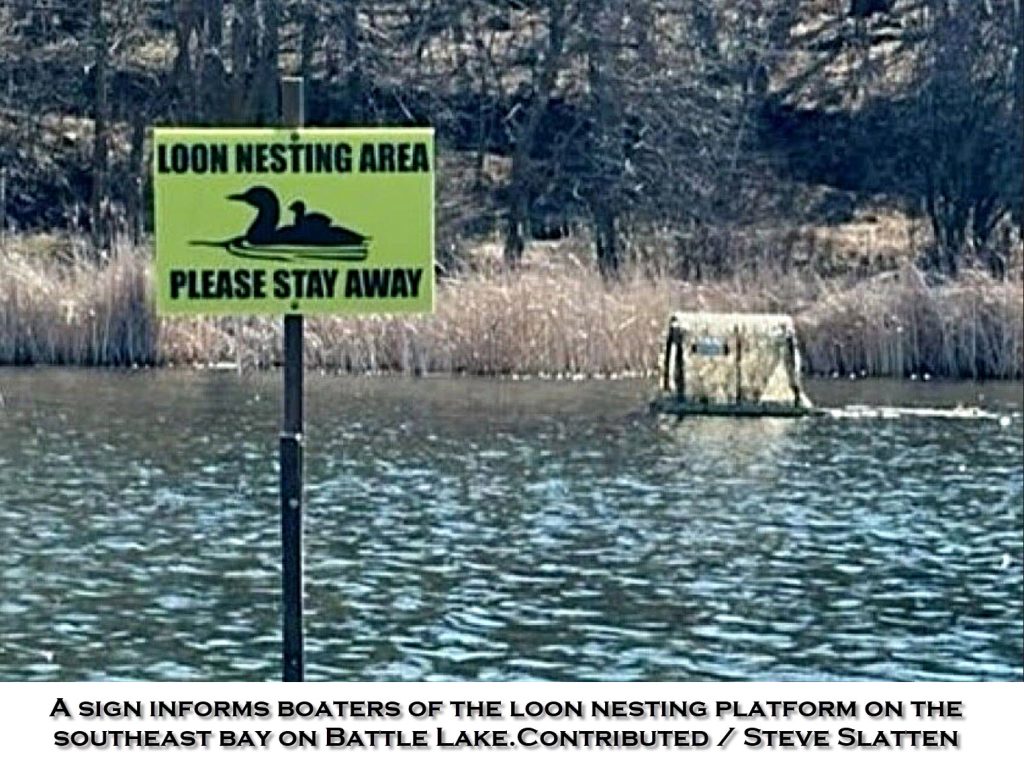
The loon nesting platform was anchored to the lakebed. Slatten also placed a sign nearby to inform anglers or boaters what the platform is and asked people to steer clear of the area to prevent disrupting the nesting area, should a loon or other waterfowl call it home.
“There is a chance a goose or duck could move in,” Slatten said. “If that is the case, I won’t evict them.”
Slatten learned about creating loon nesting platforms from a friend. Years ago, 10 loon nesting platforms were built and installed on Bay Lake, about 20 miles east of Brainerd, he said.
“Four were used,” Slatten recalled. “I thought it might work here. I could do it, so I did. It wasn’t hard to build (the nesting platforms), but it was time consuming.”
—–
Loon nesting platforms are typically built using PVC pipe, closed cell Styrofoam and chicken wire. Slatten remained true to past builds he saw and assisted with, but did add one feature — a roof. He hopes the roof helps camouflage the nest to protect the eggs and chicks from becoming meals for birds of prey, such as eagles.
—–
After the nesting structure was built, Slatten applied for a license, as required by the state. He then went a step further and wrote a letter to 12 property owners near the bay to get feedback and inform them of the project.
“I heard back from eight,” he said, noting of those who responded, seven were in favor of the project. One expressed concern that the man made nest may harm natural nesting opportunities, he said.
—–
Slatten noted loons could nest naturally in the area, and recognized the nesting platform he made may go unused. However, he has committed to installing the platform in the spring over a three-year period. In the winter, he will remove it and conduct any necessary repairs.
Tim Mitchell, Department of Natural Resources loon program coordinator based out of Brainerd, noted it can take a few years before loons use a nesting platform, if at all.
—–
For lake owners interested in a loon nesting platform, Mitchell said there should be considerations taken before applying to install one. First, monitor the lake for reproducing loons. If chicks are born, watch to see if they make it through the season. If not, try to identify what happened to the chicks, he said.
Mitchell said if chicks fall prey to mammal predators or fail to hatch, people may want to consider a location for a nesting platform. The spot should offer natural vegetation on the shoreline as well as floating aquatic vegetation.
If those comforts of home are available but no loons create a nest in that area, he said consider the size of the lake. Larger lakes may allow more sets of reproducing loons to take up residency, while small bodies of water may only be large enough for two loons looking to grow their family.
—–
“Loons are territorial, and you don’t see reproducing loons next to each other like geese,” Mitchell said, adding if a loon were to pass over a body of water, they might hear a yodel, or male call, explaining a fight awaits should they choose to land.
Man-made nests do offer some benefits that natural ones do not. Mitchell explained a nest location can be chosen to reduce access of predators, such as skunks and raccoon. The floating nest is also beneficial in a body of water that has a fluctuating water level.
“If the water rises a foot, it could flood the nest,” Mitchell said.
—–
Those who love watching loons can also share what they see with the DNR, which has two annual loon monitoring programs
“We have the loon watchers, which is open to anyone on any lake,” he said. “They record the number of loons, if they are nesting, and the number of chicks that hatch.”
The DNR Loon Monitoring Program reviews designated lakes in the counties of Otter Tail, Becker, Itasca, Cook, Aitkin and Kandiyohi. Mitchell explained assigned volunteers go onto the designated bodies of water to collect data on the same day every year. He added the report from the program is anticipated to be updated in coming weeks.